
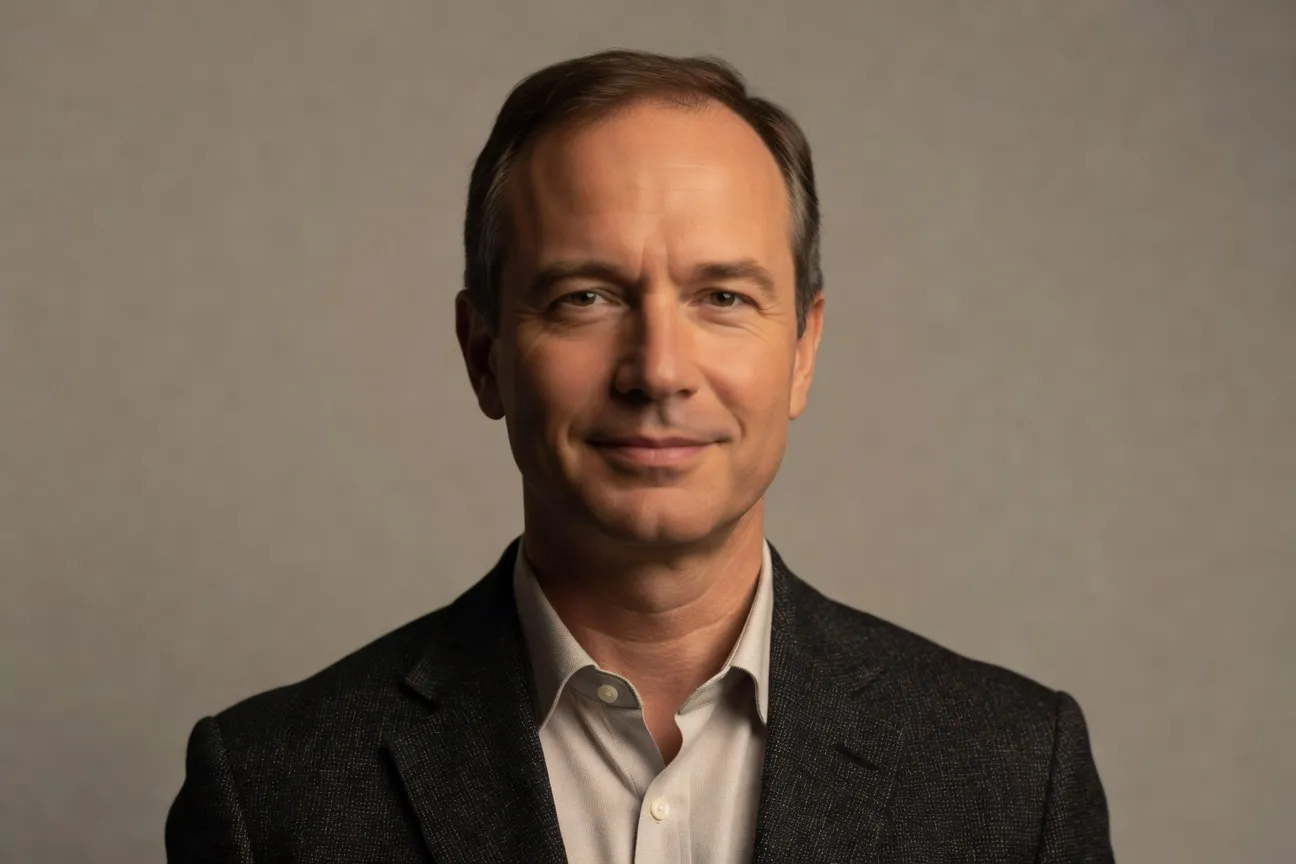
Interview conducted by Claire Vasseur, Slow Sex & Love Life. Paul Renard is an editorial composite. For editorial context: our slow sex dossier and the article on mindfulness and desire.
Why do men struggle with slow sex?
Paul, you see many men in consultation around these questions. What's blocking them?
The question of "blocking" assumes there is personal resistance. What I see instead is a massive cultural conditioning. Men who arrive with a request around slow sex often have twenty years of a sexual model behind them where performance was the only success indicator: duration, control, partner orgasm, frequency.
Slow sex asks them to let go of the only indicator they know. That is not resistance — it is a loss of bearings. My work starts with naming that clearly, before proposing anything else.
Does pornography play a role in that construction?
Massively, yes. The data from 2025 show that 73% of men aged 18-35 in France consume pornography at least weekly. What becomes ingrained is not just an aesthetic — it is a script: fast start, continuous escalation, marked climax, identifiable end. The body learns to function within that rhythm. When real intimacy offers a different tempo, the body doesn't recognise the signals and anxiety sets in.
I'm not in a moralising anti-pornography position. But the clinical impact is real and documented.
Performance anxiety: how slow sex disarms it
You talk about "performance anxiety" in consultations. How do you explain it to patients?
I use the image of the spectator in the stands. Many men watch their own sexual performance from the stands: they are simultaneously the actor and the judge. This double presence — in the experience and outside it — activates the alert system. And the alert system means cortisol, sympathetic activation, vasoconstriction. Precisely what prevents the erotic response.
Slow sex resolves this not by asking the man to "relax" — useless and often counterproductive advice — but by removing the objective. Without a goal, there is no performance to evaluate. The spectator has no match to watch.
Neuroscience: what slowness does to male desire
Is there a serious neurobiological basis for slowness in male sexuality?
Yes, and it is increasingly well-documented since 2020. Stephen Porges' polyvagal theory offers the most operational framework. There are three states of the autonomic nervous system. The social safety state (ventral vagal nerve) is the only one in which deep intimate connection is possible. Speed, performance pressure, and anxiety maintain the system in sympathetic mode — useful for survival, poorly adapted for connection.
Slowness, conscious breathing, prolonged contact — these are vagal activators. They signal to the nervous system that it is safe. This is not mystical: it is physiology.

Eye gazing and male intimacy
You use eye gazing in therapy. Is it accessible for men who are not comfortable with emotional exposure?
Prolonged mutual gaze is one of the most destabilising practices for men unfamiliar with introspection. The reason is simple: men have learned that direct gaze signals competition or threat. Not vulnerability.
In my practice, I start with very short exercises — 30 seconds, eyes half-closed — before progressing. What emerges after a few sessions is often surprising: men who are very "efficient" in their sexual life discovering that they have never really looked at their partner during intimacy.
These practices connect naturally with the broader landscape of orgasmic meditation — which, while often discussed in relation to female pleasure, offers equally valuable principles of sustained attention and non-goal-oriented presence for men.
Slow sex for men alone: conscious masturbation
Does slow sex apply to solitary male sexuality?
Absolutely, and it is something I address directly. Conscious masturbation — slowed, not focused on orgasm, exploratory — is a practice in its own right. It deconditions the script of rapid escalation, re-trains tolerance for sensation without goal, and increases general bodily presence.
For men who complain of progressive desensitisation (often linked to frequent masturbation in dopaminergic mode), this is often the first exercise I prescribe: one session per week, 20 minutes, without orgasm as objective. Observe what happens.
Practical advice: how to enter slow sex
Concretely, where do you start?
Three levels of practice depending on ease.
Level 1 — The entry breath: before any intimate contact, take 5 deep abdominal breaths. This single gesture, repeated over three weeks, qualitatively changes the experience. The body learns to enter intimacy from a state of presence, not automatism.
Level 2 — Slowing gestures: slow everything by 40% during a session. Not as an explicit technique — just internally. Observe what it does to the quality of contact, to your partner's attention, to your own sensation.
Level 3 — No explicit objective: propose an evening of intimacy "without a defined objective". No expectation of genital sexuality. Touch, presence, conversation, breathing. See what emerges. Often more powerful than a "scheduled" session.

The role of the therapist
When do you recommend that a man (or couple) seek professional help?
As soon as the symptom — premature ejaculation, low desire, intermittent erection, a feeling of absence during intimacy — generates shame or avoidance. Shame is the enemy of any transformation in this domain.
Slow sex is not therapy. It can complement therapeutic work or be a gateway to it. But if suffering is significant, professional support — a sex therapist, somatic therapist, or specialist psychologist — is indicated. There is today a new generation of therapists trained in integrative approaches that include the bodily dimension, and that is a significant development.
[Intimate communication in a couple](/en/couple-intimacy-rituals/) is often the first work to do: creating the language that allows these topics to be addressed without shame or harm.
Quick questions: common misconceptions about men and slow sexuality
- FALSE Men are biologically incapable of sexual slowness.
- TRUE Performance anxiety is a learned response, not a permanent trait.
- FALSE Slow sex is only for couples with problems.
- TRUE Most men have never received any education on bodily presence in intimate contexts.
- FALSE Slowing down reduces male pleasure.
- TRUE Pornography durably shapes male sexual scripts, but those scripts can be unlearned.
- FALSE Discussing your sex life with a therapist is a sign of weakness.
3 key takeaways
- Male performance anxiety is a learned neurological response, not destiny: the nervous system can relearn safety in intimacy.
- Slow sex for men begins with breath, not technique: a body that breathes consciously is a body that can connect.
- Slowness is not deprivation but a change of register: it opens qualities of sensation that speed makes inaccessible.
To go further on slow sex and the practices of slowed-down intimacy — including couple intimacy rituals and somatic therapy for couples — the Slow Sex & Love Life editorial team offers a research-grounded library. Perspectives on conscious masculine tension offer a useful complementary lens.