
Tantric massage often conjures stereotyped images — new-age music, scented oils, ambiguity between relaxation and desire. The reality of a serious practice is more nuanced and, in 2026, better grounded in science than ever.
Researchers like Stephen Porges (author of polyvagal theory) and Peter Levine (founder of Somatic Experiencing) have shown that slow, ritualised touch acts directly on the autonomic nervous system, in direct alignment with the principles of slow sex. It activates the vagus nerve, lowers cortisol levels, and promotes what Porges calls the “social safety” state — a neurobiological window in which intimate connection becomes possible. This is the scientific foundation of what tantric traditions had intuitively integrated for centuries.
Tantric massage vs classic massage: what changes
Classic massage — Swedish, deep tissue, relaxation — has a mechanical objective: release muscle tension, improve circulation, induce relaxation. The practitioner works on the body.
Tantric massage starts from a different premise: touch as a form of communication, not technique. What changes:
- Rhythm: slower, aligned with breath
- Intention: complete presence, not technical performance
- Reciprocity: both partners are active, even in the passive position
- Objective: quality of contact, not muscle relaxation
- Frame: defined entry and exit rituals
In Lori Brotto’s work (UBC, Better Sex Through Mindfulness, 2018), the main problem with hypoactive sexual desire disorder in women is mind-body dissociation: the body receives stimulation without the mind being present. Tantric massage directly addresses this dissociation by demanding sustained attention to sensation.
Preparing body and space (polyvagal theory 2026)
Porges’ polyvagal theory distinguishes three physiological states: the safety mode (ventral vagal nerve), the danger mode (sympathetic system), and the immobilisation mode (dorsal vagal nerve). The quality of a tantric massage depends entirely on creating and maintaining the conditions of the first state.
Preparing the space:
- Room temperature slightly above comfortable (22-23°C)
- Dim lighting, candles if possible — low light inhibits the alertness state
- Enough space to move freely around a futon or large mat
- Phones on airplane mode, notifications off
- 60-90 minutes guaranteed without interruption
Preparing the body:
- A warm shower for both partners — a transition ritual, not just hygiene
- A few minutes of shared abdominal breathing (3-5 cycles)
- A brief verbal intention: “Tonight I offer my presence”
Warm massage oil between the hands before first contact activates skin thermoreceptors and prepares the nervous system for safety.
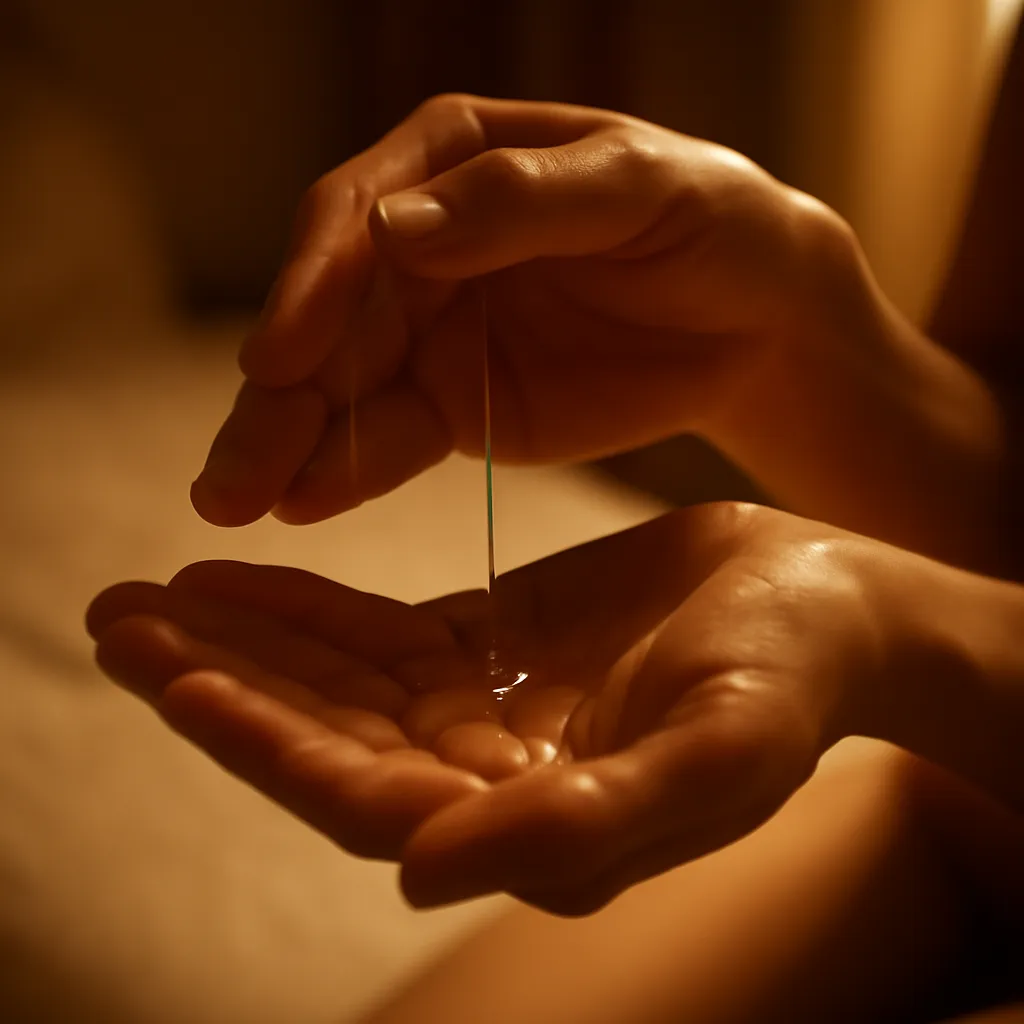
The 8 fundamental gestures of tantric massage
These eight gestures are not isolated techniques but a progression. Each builds on the previous.
1. The hand welcome (2 minutes) — Lay both hands flat on the lower back of the partner lying face down. Don’t move. Breathe. Let the warmth of your hands merge with the warmth of their skin.
2. Long effleurages (5-8 minutes) — Slowly rise from the lower back to the shoulders following the paravertebral muscles, without strong pressure. Return. Vary the angle slightly with each pass.
3. Shoulder mapping (5 minutes) — The trapezoids and rhomboids store most emotional tension. Begin with wide circles, then progressively reduce the radius toward palpable knots.
4. Awakening the extremities: feet (8-10 minutes) — Hold the whole foot in both hands, press the arch, work each toe separately. Activation of plantar receptors has a calming effect on the central nervous system documented in laboratory settings.
5. Energy passes (3 minutes) — A few centimetres from the skin, traverse the body from head to toe without direct contact. Skin thermoreceptors perceive the warmth of hands at a distance.
6. Thorax opening (front) — Your partner turns over. Place both hands on the sternum. Work in a fan shape outward. The anterior thorax is the zone of vulnerability.
7. Breath synchronisation (2-3 minutes) — Switch roles briefly. A short synchronisation of breathing rhythms before inverting positions grounds the transition.
8. Final presence (5 minutes) — At the end of the massage, maintain simple contact — one hand on the heart, one on the belly — for five minutes. Do nothing. Breathe together.
This gesture-based attention connects with the principles of orgasmic meditation — another practice that cultivates sustained mindful attention to bodily sensation.
Breath synchronisation during massage
Cocircular breathing (taught by Diana Richardson) is a powerful tool during tantric massage. In practice: the person being massaged guides their breath toward the touched area on the inhale, and releases tension on the exhale. The giver synchronises movements with this cycle.
Somatic cartography: non-genital pleasure zones
Contemporary sexology has documented the importance of non-genital erogenous zones in sexual response. Tantric massage is an opportunity to explore them without the objective of stimulation:
- The nape of the neck: richly innervated, very sensitive to gentle touch
- The inner forearms: physiological vulnerability zone
- The backs of the knees and inner thighs: proximity without transgression
- The floating ribs: often ignored, very receptive
- The scalp: massage with open fingers, slowly
When one partner is inhibited or stressed
If your partner stiffens, holds their breath, or signals discomfort:
- Reduce the contact area: stay with hands and feet until safety is established
- Slow down even more: the pace that already seems slow is often still too fast
- Verbalise gently: “What’s happening for you right now?”
- Offer choice: “Should I continue or shall we pause?”
The conscious closing
After massage, resist the urge to transition immediately. A conscious closing:
- Stay lying together for another 5-10 minutes
- A brief word if it comes naturally — silence is preferable otherwise
- A warm shared drink
- Avoid consulting your phone for the first 20 minutes
The neurobiology here is clear: oxytocin released during tactile contact takes 15-20 minutes to reach its peak blood level. Breaking contact prematurely cuts the hormonal cycle before its completion.
Common mistakes
Confusing slowness with inertia. Tantric massage is slow, not frozen. The hand doesn’t stop — it moves with intention, simply at a different pace.
Looking for a reaction. Observing your partner’s face to validate that you’re “doing well” breaks inner presence. Closing your eyes as the giver allows you to stay in sensation.
Skipping the ritual steps. Entry and exit are not optional. They are the markers that transform ordinary touch into conscious practice.
Resources to go further
Among serious references available in English in 2026:
- Diana Richardson, Slow Sex (Destiny Books, 2011)
- Margot Anand, The Art of Sexual Ecstasy (Tarcher, 1989, reissued 2021)
- Peter Levine, In an Unspoken Voice (North Atlantic Books, 2010)
For couples who wish to enrich their sensory environment, thoughtfully chosen accessories can support this exploration of mindful sexuality. The female body and pleasure page offers complementary perspectives on building intimate rituals. An exploration of tantric anatomy and pleasure rounds out this cartography.