
There is a persistent idea, rarely stated aloud but deeply embedded in collective imagination: sexuality is a young person’s territory. It is represented as young, fast, urgent — as though desire were a resource to exhaust rather than a landscape to explore. This framing impoverishes the experience of those who, past sixty, continue to live a rich, nuanced intimate life — sometimes more profound than anything they experienced in youth.
The scientific data contradict this picture directly. A study published in 2007 in the New England Journal of Medicine by Stacy Lindau and colleagues, surveying 3,005 American adults aged 57 to 85, found that 73% of adults aged 57–64 and 53% of those aged 65–74 remained sexually active. More remarkable still: among sexually active participants, reported satisfaction was overwhelmingly positive — and for many, greater than in their younger years. Mindful sexuality finds particularly fertile ground here: where haste and performance give way to presence and depth, intimacy can reveal itself in its fullest human dimension.
The prejudices around sexuality after 60
The first obstacle to a fulfilling intimate life after 60 is not physiological. It is cultural. The sexuality of adults over 60 is either ignored or mocked in media representations. On the rare occasions it is acknowledged, it tends to come with benevolent condescension — “how touching that they still…” — which says everything about the ambient ageism. This invisibility has real consequences: it generates a silent shame in adults who feel “abnormal” for still desiring, or a resignation in those who have internalised the idea that they “should not” anymore.
Esther Perel, couples therapist and author of Mating in Captivity, observes that long-term desire within a couple does not extinguish mechanically with time — it transforms. What sometimes dies is the infantile form of desire: urgency, novelty, transgression. What can emerge in its place is often richer: an intimacy built on years of mutual knowledge, a capacity to be truly present to the other, a freedom that did not exist at thirty. Adults over 60 who maintain an active sexual life are not “resisting ageing” — they are fully inhabiting their age.
Large-scale epidemiological surveys in both North America and Europe document a significant persistence of sexual activity well beyond 60. The idea of a “cut-off” at any particular age is statistically false: the data show great individual variation and continuity of trajectories that invalidate any determinism. What these findings also confirm: the obstacles to sexuality after 60 are rarely an absence of intrinsic desire. They are linked to widowhood (which mechanically reduces opportunity), untreated health problems, poorly adjusted medications — and above all to an absence of dialogue: with oneself, with one’s partner, with one’s doctor.
Physiological changes: understanding in order to adapt
Recognising the bodily changes that come with age — without dramatising them — is a form of intimate intelligence. These changes are real; ignoring them does not make their impact disappear. Understanding them allows us to respond with creativity and care rather than anxiety.
In women, menopause — which occurs on average between ages 45 and 55 — brings a significant decline in oestrogen. The direct consequences for sexuality include vaginal dryness, thinning of vaginal walls (vaginal atrophy), and a longer time needed for natural lubrication. These phenomena are real and measurable — and largely treatable. Water- or silicone-based lubricants, available without prescription, are a simple and effective first step. Local hormonal treatments (oestrogen creams or vaginal rings) restore the health of vaginal tissue without the risks associated with systemic hormonal therapy. A dedicated gynaecological consultation is the most direct route to personalised solutions.
In men, the picture is different. Testosterone production declines gradually from around age 40 — roughly 1% per year. Sexual effects include erections that are less frequent and less firm without direct stimulation, a longer recovery time between erections, and sometimes a reduction in ejaculation volume. What men over 60 often describe as “failure” is in reality a normal transformation of erectile function. The key insight: more direct and sustained stimulation is needed to achieve and maintain an erection — which naturally slows the entire encounter, paradoxically favouring a more conscious, more attentive sexuality.
It is essential not to pathologise these changes. A sixty-year-old man who needs fifteen minutes of stimulation where he once needed five is not “broken” — he is simply different. A woman who struggles without lubrication is not “cold” — she simply has lower oestrogen levels. These adjustments call for a quality of communication between partners that the sexuality of youth rarely required. And this communication is precisely at the heart of what makes mature intimacy potentially richer.
What research also indicates: the best protection against age-related decline in sexual function is regular sexual activity itself. Prolonged inactivity worsens vaginal atrophy in women and diminishes erectile capacity in men. Regular engagement of the sexual organs — alone or together — maintains their functional health. Biology here confirms what common sense suggests: do not stop.
Why slow sex is particularly well-suited after 60
The philosophy of slow sex rests on one central principle: quality of presence takes precedence over performance. Slowing down, feeling, inhabiting each moment of contact rather than rushing toward an objective. This conceptual framework resonates deeply with what bodies over 60 naturally offer.
First reason: the natural rhythm of mature bodies. What youth sometimes interprets as an obstacle — the time required for lubrication, for erection, for sensory awakening — becomes in slow sex an invitation. Slowing down is no longer an externally imposed constraint: it is simply the authentic cadence of the mature body. This reconciliation between physiological reality and cultural ideal can be genuinely liberating.
Second reason: the absence of performance pressure. At 25, sexuality is often loaded with questions of identity — proving one’s masculinity or femininity, satisfying assumed expectations, reaching orgasm within an “acceptable” timeframe. After 60, much of this weight has lifted. Experience has usually demonstrated that pleasure does not reduce to performance. This freedom is an extraordinary resource for conscious sexuality.
Third reason: deeper self-knowledge. Four decades of bodily life provide an intimate cartography that youth simply does not have time to build. Knowing what makes one’s body resonate, understanding one’s zones of sensitivity, recognising the emotional, temporal and relational conditions under which pleasure emerges — this knowledge is a richness that only time can give.
Fourth reason: temporal availability. For many adults over 60, children have left home, professional demands have eased or ended, and the tempo of life has transformed. This availability — of time, of mental space, of a presence less fragmented by daily urgencies — creates ideal conditions for a more intentional, more ritualised, less clock-driven sexuality.
Fifth reason: emotional proximity with a long-term partner. Couples who traverse decades together develop a unique cognitive intimacy — the capacity to read each other, to sense, to understand silences as much as words. This relational depth, when cultivated with care, becomes an extraordinary substrate for physical intimacy. What young couples sometimes seek in novelty, mature couples can find in depth.
Mindfulness and acceptance of the ageing body
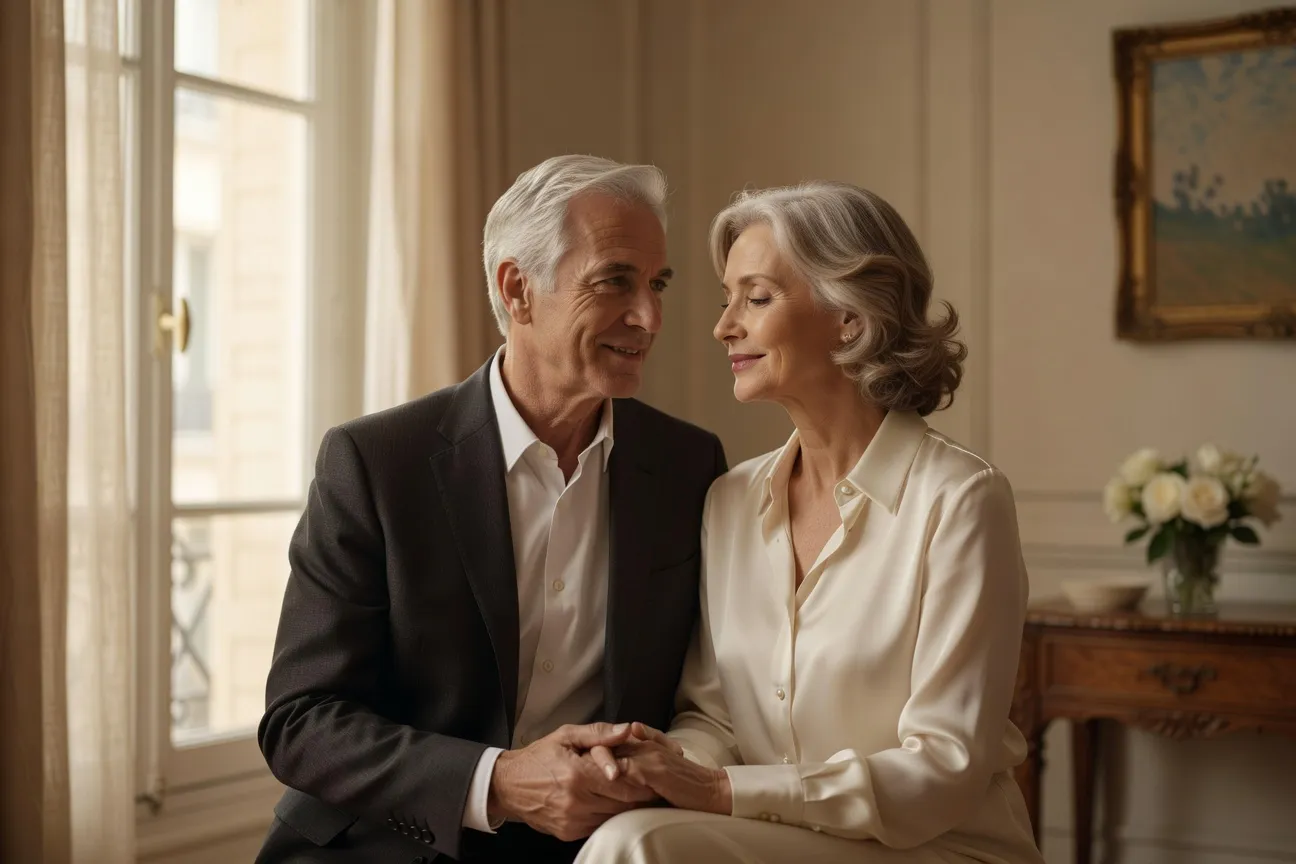
The relationship to one’s body is perhaps the most intimate challenge of sexuality after 60. Not the wrinkles themselves, nor the extra weight, nor the grey hair — but the gaze one brings to all of this. Body shame has no age, but after 60 it takes a particular colouring: the sense that one no longer “deserves” the desiring gaze of another, or that one must apologise for existing in a body that no longer resembles those celebrated in advertising.
Researcher Kristin Neff, a pioneer in self-compassion studies at the University of Texas, distinguishes three components of self-compassion: kindness toward oneself, recognition of common humanity (all humans suffer and age), and mindfulness — that is, observing difficult thoughts without identifying with them. These three components apply directly to our relationship with the ageing body.
Self-kindness in this context means speaking to one’s body with the same gentleness one would use with a close friend. Not denial of what changes, but not merciless criticism either. An active acceptance that recognises the value of a body that has lived, that has carried, that has felt.
Bodily mindfulness — the body scan — is a particularly well-adapted practice. It involves progressively directing attention toward each part of the body, not to evaluate it, but to feel it. Ten to twenty minutes of body scan practice daily, done regularly, progressively reconfigures one’s relationship to the body: the shift is from an external gaze (how my body is seen) to an internal one (what my body feels). This shift is foundational for conscious sexuality at any age, but it is particularly powerful after 60, where cultural injunctions about the “desirable” body have had decades to settle.
Acceptance meditation — distinct from pleasure meditation — proposes specific work on what resists. Rather than ignoring the discomfort one may feel facing one’s own naked body, it involves gentle, curious exposure. One notes the thought (“my belly is too soft”), recognises it as a thought rather than a fact, and chooses to respond with kindness rather than allowing it to govern the experience. This practice, taught within MBSR (Mindfulness-Based Stress Reduction) programmes, produces measurable effects on body image.
It is also worth remembering what long-term partners often know intuitively: desire is not a response to a perfect body. It is a response to a presence, a shared history, a trust that has been built. Adults over 60 who have shared a relationship for thirty years do not need physical perfection to be desired — they need to be present.
Practices such as orgasmic meditation offer structured entry points into this mindful bodily presence — particularly relevant for those returning to intimacy after a period of estrangement from desire.
6 intimacy rituals adapted to mature life
Intimacy rituals — intentional, regular gestures that signal to the other (and to oneself) that closeness is a priority — are particularly valuable in the second half of life. Here are six concrete practices adapted to the bodies and rhythms of maturity.
1. Conscious touch without goal. Set aside twenty to thirty minutes to touch each other without agenda — no objective of arousal, no pre-established destination. One partner touches; the other receives. Then switch. Attention is brought to pure sensation: the texture of skin, warmth, pressure. This practice, close to the sensate focus technique developed by Masters and Johnson, defuses performance anxiety and re-engages the pleasure circuit in its most primary dimension.
2. Shared breathing. Sit facing each other, knees touching, eyes closed or half-open. Gradually synchronise your breath with your partner’s — inhale together, exhale together — for five to ten minutes. This simple practice creates a state of physiological coherence between partners. It activates the parasympathetic nervous system (rest, receptivity) and reduces sympathetic activity (urgency, performance). It is often a gentle doorway into deeper physical intimacy.
3. Shared warm bath. Warm water dilates blood vessels, reduces muscular tension, and creates a space outside of time. A shared bath — without pressure to “do something” — is an intimacy ritual that combines physical comfort, bodily closeness and mental relaxation. After 60, when joints may be more sensitive and bodies tire more readily, warm water is also an act of care.
4. Non-sexual massage. Twenty minutes of massage — back, feet, hands, scalp — without sexual intention. Caring physical contact stimulates oxytocin production (the bonding and trust hormone), lowers cortisol, and reinforces the sense of safety in the relationship. This ritual can remain non-sexual — which is in itself a complete form of intimacy — or it can become an entry point toward more sexual closeness if both partners wish it.
5. Reading aloud. Reading to your partner — a poem, a passage from a loved book, a page from a shared travel journal — is a form of cognitive intimacy that is often underestimated. The human voice reading is a physical vibration as much as an intellectual one. It creates a space of sharing that is not about performance but about presence. After 60, when one has often developed a shared library of cultural references, this ritual can also be an exploration of shared history.
6. A daily moment of presence. Fifteen minutes each day — without phones, without television, without other activity — dedicated to intentional mutual presence. It might be a coffee drunk in silence while looking at each other, a walk with no destination, a conversation without urgency. This ritual builds the relational soil in which sexual intimacy can grow. Couples who maintain an active sexual life after 60 often share one trait: they continue to actively choose each other, daily.
Communication: the keystone of mature sexuality
Sexuality after 60 often calls for an explicit, verbal, benevolent renegotiation of couple intimacy. What worked at 35 may no longer fit — not because love has diminished, but because bodies have changed, desires have evolved, and needs for care and tenderness have shifted. This renegotiation is a form of relational maturity, not a confession of failure.
Marshall Rosenberg, creator of Nonviolent Communication (NVC), proposed a four-step framework that applies particularly well to these conversations: observe facts without judgment (“over the past few months, we have had no sexual intimacy”), identify feelings (“I feel alone, a little sad”), express the underlying need (“I need physical closeness, to feel desired”), and make a concrete request (“could we set aside some time this week to be close to each other?”).
What makes these conversations difficult is not a lack of goodwill — most long-term partners share that. It is the absence of a language for speaking about sexuality outside the context of urgency or complaint. Developing this language — learning to express what one desires, what one enjoys, what has changed — is a skill that can be learned. Couples communication workshops, sessions with a sex therapist or couples therapist, and dedicated reading (Esther Perel, John Gottman, David Schnarch) all offer real resources for building this vocabulary.
Communication around sexuality also includes the topic of medication. Many common treatments after 60 — antihypertensives (beta-blockers, calcium channel blockers), antidepressants (SSRIs in particular), prostate treatments (alpha-blockers), certain antihistamines — have documented effects on sexual function. These effects are often silent: neither the prescribing doctor nor the patient raises them, and the person lives with the impact without understanding its cause. Naming these effects to one’s doctor — “since starting this treatment, I have noticed changes in my intimate life” — frequently opens the possibility of an adjustment or therapeutic alternative.
The most important communication, finally, is the one we maintain with ourselves. What image does one hold of one’s own sexuality at 60 or 70? Is that image marked by shame and resignation, or by curiosity and openness? The way we narrate our own sexual history has a direct influence on the possibilities we allow ourselves. Research in the psychology of ageing consistently shows that people who maintain a positive self-image around their sexuality age with a significantly richer intimate life. There is also a well-documented connection between depression in retirement and its links to intimacy: depressive states, which are common following the transition to retirement, have a direct impact on libido and on the capacity to invest in an intimate relationship — making mental health care inseparable from sexual wellbeing in later life.
Professional resources and support
A fulfilling sexual life after 60 is not the result of heroic effort against biology — it is built with care, curiosity, and sometimes the help of competent professionals. Knowing where to turn is itself a skill.
A certified sex therapist or clinical sexologist is the most directly qualified professional for questions of sexuality at any age. These practitioners are trained to integrate the physiological, psychological and relational dimensions of mature sexuality into a coherent picture. A consultation requires no medical referral and can be undertaken individually or as a couple.
A gynaecologist or urologist addresses the medical dimensions: vaginal atrophy, dryness, pain during intercourse for women; erectile difficulties, prostate enlargement, medication interactions for men. These specialists can offer effective medical solutions that transform sexual quality of life without invasive treatments.
A couples therapist — psychologist or systemic therapist — is particularly useful when the difficulties are relational: accumulated emotional distance, blocked communication on intimate topics, or navigating a life transition such as retirement or the departure of the last child from home. The couple intimacy rituals that sustain long-term desire often need to be deliberately rebuilt at these junctures, and a skilled therapist can facilitate that process.
On the reading side, several resources are worth naming. Esther Perel’s Mating in Captivity addresses long-term desire in the couple with rare clinical and literary depth. David Schnarch’s Passionate Marriage offers a solid therapeutic framework around differentiation of self in intimate relationships — particularly relevant after decades together. Lori Brotto’s Better Sex Through Mindfulness translates current mindfulness research into practical tools for sexual wellbeing. For the physiological side, Dr. Christiane Northrup’s The Wisdom of Menopause is an evidence-grounded and empowering resource for women navigating this transition.
The relationship to bodily pleasure and the body itself is also a territory cultivated through regular practice. Gentle yoga, tai chi, qigong — all disciplines that develop bodily awareness, balance and flexibility — contribute indirectly to a more embodied sexuality. Several studies document a positive correlation between regular yoga practice and sexual satisfaction in adults over 55, particularly via improved pelvic blood flow and reduced body anxiety.
The final point — perhaps the most fundamental: there is no age at which it becomes “normal” to give up on intimacy. If that decision is made, it should be the result of a free and informed choice — not a capitulation before impoverished cultural representations or before untreated symptoms. Adults over 60 who have questions about their sexual lives, who feel curiosity or nostalgia, who wish to deepen intimacy with a partner, have access to real resources, to competent professionals, and to a range of practices — including slow sex — that accord deeply with what maturity offers at its best.
Sexuality is not a chapter one closes. It is a language one continues to learn — and one that grows richer with time, experience, and the depth of what has been lived. The slow sex path offers one of the most coherent frameworks for this continuing journey: presence without performance, sensation without destination, intimacy as an ongoing practice rather than a goal to achieve.
For a deeper understanding of female hormonal changes and their impact on sexual health with age, clitoris-moi.ch provides a valuable clinical perspective on the role of testosterone in women’s sexual wellbeing.